Haldi-Based Meals for Joint Pain: What Turmeric Can and Can’t Do
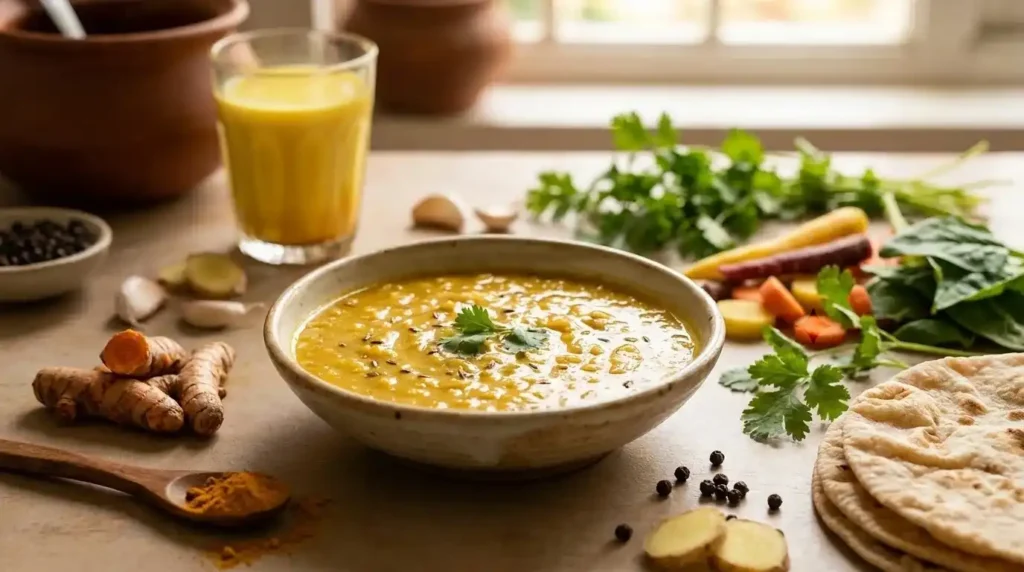
Turmeric, or haldi, has been part of Indian cooking for generations. It brings a warm golden color to dal, vegetables, rice, curries, and drinks, and its earthy flavor works with everything from ginger and garlic to coconut milk and roasted vegetables.
It has also become popular for another reason: people are interested in whether turmeric can help with inflammation and joint discomfort.
There is some scientific interest here, but the story is more nuanced than “haldi cures joint pain.”
Turmeric contains curcuminoids, including curcumin, which have been studied for their biological effects. Research on turmeric and curcumin supplements has produced promising findings for some measures of knee osteoarthritis, including pain and stiffness, but the evidence is not strong enough to say that turmeric treats every kind of joint pain. The National Center for Complementary and Integrative Health says the early evidence is positive but that higher-quality research is still needed.
There is also an important difference between eating turmeric as a culinary spice and taking a concentrated curcumin supplement. A clinical study using a concentrated extract is not proof that adding a teaspoon of turmeric to a meal will produce the same effect.
That distinction is at the center of this guide.
Rather than promising a healing meal, we will show you how to use haldi in flavorful, balanced food while explaining what is actually known about turmeric, curcumin, joint health, absorption, safety, and supplements.
You will also get practical Indian-inspired recipes, meal-prep ideas, ingredient substitutions, storage advice, and a simple seven-day meal-planning framework.
For a broader whole-food approach to everyday eating, see Natural Diet Plan for Active Men: The Complete Whole Food Nutrition Guide
Table of Contents
What Makes Haldi Interesting for Joint Health?
Turmeric is the underground rhizome of Curcuma longa, a plant related to ginger.
The familiar yellow-orange color comes largely from curcuminoids, a group of plant compounds that includes curcumin.
Curcumin has been studied because of its antioxidant and anti-inflammatory activity in laboratory and human research. Johns Hopkins Medicine describes the evidence as promising but still developing, particularly for joint discomfort and inflammation.
That sounds encouraging, but there is an important limitation.
A food can be nutritious without being a medicine.
When you add turmeric to dal, vegetables, rice, soup, or milk, you are primarily using it as a culinary ingredient. The amount of curcumin delivered by ordinary cooking is much lower and less standardized than the amounts used in many supplement studies.
So the most useful way to think about haldi is:
A flavorful spice that can be part of a nutritious eating pattern, with potentially interesting compounds that researchers are still studying.
That is a stronger and more honest message than telling readers that turmeric meals will eliminate arthritis pain.
Why the overall meal matters
A meal containing turmeric can also contain:
vegetables
lentils or beans
whole grains
protein foods
nuts and seeds
healthy fats
herbs and spices
That combination may be more meaningful for everyday nutrition than focusing on one ingredient.
For seasonal, whole-food meal inspiration, see our Easy Seasonal Recipes guide.
Turmeric vs. Curcumin: What Is Actually Being Studied?

The terms “turmeric” and “curcumin” are often used as though they mean exactly the same thing.
They do not.
Turmeric is the whole spice.
Curcumin is one group of compounds found in turmeric.
Turmeric contains several curcuminoids as well as volatile oils and other plant compounds.
This distinction matters because many clinical studies use standardized curcumin extracts rather than ordinary culinary turmeric.
A capsule containing a concentrated curcumin preparation can therefore be very different from a spoonful of turmeric powder used in cooking.
The National Center for Complementary and Integrative Health notes that oral turmeric and curcumin products vary considerably in formulation and that some products are designed to increase bioavailability.
This is one reason you should not take a study involving a concentrated curcumin formulation and turn it into a cooking prescription.
What about turmeric’s other compounds?
Curcumin receives most of the attention, but turmeric contains other compounds as well.
Turmeric’s aroma comes partly from volatile oils, and the overall spice contains a variety of plant compounds.
Food does not need to be reduced to one “active ingredient” to be worthwhile.
Using several herbs, spices, vegetables, legumes, grains, nuts, seeds, and other whole foods gives meals a much broader nutritional profile.
That is the approach this guide follows.
What Does the Research Say About Turmeric and Joint Pain?

The evidence is promising, but it still needs to be interpreted carefully.
Several systematic reviews and clinical trials have investigated turmeric or curcumin for knee osteoarthritis.
A 2025 systematic review and network meta-analysis included 17 randomized controlled trials of different turmeric preparations for knee osteoarthritis. The researchers found reductions in pain with several preparations, but the certainty of the network evidence was low to very low, so the findings should be interpreted cautiously. NCCIH likewise says the initial evidence for osteoarthritis is positive, but higher-quality research is still needed before firm conclusions can be drawn.
That means the responsible conclusion is
Turmeric and curcumin are promising areas of research for some forms of joint discomfort, especially knee osteoarthritis, but they should not be presented as a proven treatment for all joint pain.
There is another important point.
Most of the evidence concerns specific turmeric or curcumin preparations.
It does not establish that every turmeric-containing meal produces the same effect.
What about rheumatoid arthritis?
Rheumatoid arthritis is an autoimmune disease and is very different from ordinary wear-and-tear osteoarthritis.
Food can certainly be part of a healthy diet for someone living with rheumatoid arthritis, but turmeric meals should not be presented as a replacement for medical treatment.
The same principle applies to gout, joint infections, injuries, and unexplained swelling.
The cause of joint pain matters.
A spice cannot diagnose the cause.
For that reason, this article focuses on food and cooking, not disease treatment.
Turmeric in Food vs. Curcumin Supplements
For everyday use, the distinction between culinary turmeric and concentrated supplements matters.
Eating turmeric in normal cooking quantities and taking a concentrated curcumin supplement are not equivalent.
Food contains relatively small and variable amounts of curcumin.
Supplements can contain much more concentrated extracts, and some are formulated specifically to increase absorption.
NCCIH notes that highly bioavailable curcumin formulations may carry additional safety concerns, including reports of liver injury. Conventional oral turmeric used in recommended amounts is generally considered safer, while concentrated products deserve greater caution.
Johns Hopkins Medicine similarly recommends thinking of turmeric primarily as a food ingredient rather than assuming that larger supplemental doses are automatically better.
More is not necessarily better.
A common mistake is
“I heard turmeric may help, so I should consume a very large amount.”
That is not a sound conclusion.
Increasing the quantity does not automatically increase the benefit.
A culinary spice should be used primarily to make food enjoyable.
A supplement is a different matter and should be discussed with a qualified healthcare professional when someone has a medical condition, takes medication, is pregnant, or is considering concentrated doses.
Food-first is a sensible approach.
For most healthy adults who simply enjoy turmeric, using it in normal cooking is a straightforward way to include it in the diet.
You do not need capsules, gummies, extracts, or unusually large doses to make your meals interesting.
Does Black Pepper Really Make Turmeric Work Better?

The black-pepper-and-turmeric combination is widely discussed because piperine, a compound in black pepper, can increase the bioavailability of curcumin.
NCCIH specifically notes that combining curcumin with piperine is one way researchers have increased curcumin’s bioavailability.
But there is an important difference between:
increasing absorption of a compound
and
proving that a meal treats joint pain.
The two are not interchangeable.
You can certainly pair turmeric with black pepper because the flavors work well together.
You do not need to add excessive amounts of pepper.
A small amount is enough for flavor.
What about fat?
Turmeric is also commonly cooked with fat-containing ingredients such as:
oil
ghee
coconut milk
milk
nuts
seeds
This works well from a culinary perspective.
It also fits naturally into many Indian recipes where spices are bloomed in oil or cooked into gravies.
You do not need to turn this into a rigid “turmeric absorption formula.”
A good curry or dal already provides a natural combination of spices, vegetables, legumes, and cooking fat.
That is one of the strengths of traditional cooking.
How to Build a Balanced Haldi-Based Meal
A turmeric meal should still be a meal.
That sounds obvious, but it is easy to lose sight of when an ingredient becomes popular for a particular health claim.
A practical plate can include:
Vegetables for color, fiber, texture, and variety
Protein such as lentils, beans, eggs, fish, chicken, tofu, or another appropriate source
A carbohydrate food such as rice, roti, oats, potatoes, or another grain or starch according to your needs
Healthy fats such as nuts, seeds, olive oil, or other cooking fats
Spices and herbs for flavor
Turmeric then becomes one part of the meal instead of the entire purpose of the meal.
Example
A simple lunch could be:
turmeric dal
mixed vegetables
a moderate serving of rice or roti
cucumber salad
fresh coriander
The dal does not need to be called an “anti-inflammatory treatment.”
It is simply a nutritious, flavorful meal that happens to contain haldi.
Another example
Dinner could be:
turmeric-seasoned chicken or tofu
roasted cauliflower
green beans
a small portion of rice
plain yogurt or another suitable accompaniment
Again, the goal is balanced food.
For a broader whole-food meal framework that includes protein, vegetables, grains, hydration, and meal planning, see Natural Diet Plan for Active Men
Easy Haldi Breakfast Recipes

Breakfast is one of the easiest places to use turmeric because its earthy flavor pairs well with oats, milk, eggs, fruit, and warming spices.
Golden Turmeric Milk
Serves: 1
Ingredients
1 cup milk or an unsweetened plant-based alternative
½ teaspoon ground turmeric
A small pinch of black pepper
¼ teaspoon ground cinnamon
A small amount of fresh ginger, grated, optional
Sweetener, optional
Method
Add the milk, turmeric, cinnamon, ginger, and black pepper to a small saucepan.
Warm gently while stirring.
Do not boil aggressively.
Taste and add a small amount of sweetener if desired.
Serve warm.
This is a comforting drink, not a guaranteed pain-relief treatment.
If you use a plant-based milk, choose one that suits your dietary needs and taste.
Turmeric Overnight Oats
Serves: 1
Ingredients
½ cup rolled oats
½ cup milk or unsweetened plant milk
¼ cup plain yogurt, optional
¼ teaspoon turmeric
¼ teaspoon cinnamon
1 tablespoon chia seeds
½ banana, sliced
1 tablespoon chopped walnuts
Method
Combine the oats, milk, yogurt, turmeric, cinnamon, and chia seeds in a jar.
Stir thoroughly.
Cover and refrigerate overnight.
In the morning, top with banana and walnuts.
The turmeric should remain subtle.
You are making breakfast, not a turmeric paste.
Optional variation
Add grated ginger, berries, or a small amount of unsweetened cocoa powder.
For more ideas for using fresh fruit in everyday meals, see our Tropical Fruit Salads guide.
Savory Haldi Besan Chilla
Serves: 2
Ingredients
1 cup besan
½ teaspoon turmeric
¼ teaspoon cumin
Finely chopped onion
Finely chopped coriander
Chopped green chili, optional
Water as needed
Salt to taste
A small amount of cooking oil
Method
Combine the besan, turmeric, cumin, salt, coriander, onion, and chili.
Add water gradually until you have a pourable batter.
Heat a lightly greased pan.
Pour a portion of batter and spread it into a thin round.
Cook on both sides until set and lightly browned.
Serve with plain yogurt, cucumber, or a vegetable side.
This is a particularly useful example of how turmeric can fit naturally into an Indian breakfast without making a medical promise.
Practical Haldi Lunch Recipes

Everyday Turmeric Dal
Serves: 4
Ingredients
1 cup washed yellow or red lentils
½ teaspoon turmeric
1 teaspoon cumin seeds
Fresh ginger
Garlic, optional
Tomato, chopped
Spinach, optional
Water
Salt
A small amount of cooking oil or ghee
Fresh coriander
Method
Rinse the lentils.
Cook them with water and turmeric until tender.
In a separate pan, warm the cooking fat.
Add cumin, ginger, garlic, and tomato.
Cook until the mixture softens.
Add the cooked lentils.
Stir in spinach near the end if using.
Adjust consistency with water.
Finish with fresh coriander.
Serve with rice or roti and a vegetable side.
This recipe works particularly well because turmeric is not isolated from the rest of the meal. It becomes part of a familiar combination of lentils, vegetables, herbs, and spices.
Haldi Chickpea and Vegetable Bowl
Serves: 2
Ingredients
1½ cups cooked chickpeas
½ teaspoon turmeric
1 cup chopped cucumber
1 cup chopped bell pepper
½ cup grated carrot
Fresh coriander
Lemon juice
Small amount of olive oil
Black pepper
Salt
Optional: pumpkin seeds
Method
Warm the chickpeas with turmeric and a little oil.
Allow them to cool slightly.
Combine with cucumber, bell pepper, carrot, coriander, lemon juice, black pepper, and salt.
Add pumpkin seeds if desired.
Serve in a bowl on its own or alongside whole grains or flatbread.
Make it more filling
Add a boiled egg, grilled chicken, tofu, or another protein according to your preference.
The important part is not the turmeric quantity.
It is creating a meal you can realistically eat as part of your normal routine.
Satisfying Haldi Dinner Recipes

Turmeric Vegetable Khichdi
Serves: 4
Ingredients
½ cup rice
½ cup moong dal
½ teaspoon turmeric
1 cup mixed vegetables
Fresh ginger
Cumin seeds
Salt
Water
A small amount of ghee or oil
Fresh coriander
Method
Rinse the rice and dal.
Heat a little ghee or oil.
Add cumin and ginger.
Add turmeric, rice, dal, vegetables, salt, and water.
Cook until soft and creamy.
Adjust the consistency according to your preference.
Finish with coriander.
This is a good example of a turmeric-based meal that does not rely on a long list of exotic ingredients.
Turmeric Chicken and Vegetable Skillet
Serves: 2–3
Ingredients
300–400 g chicken breast or thigh
½ teaspoon turmeric
½ teaspoon cumin
¼ teaspoon black pepper
Garlic
Ginger
Bell pepper
Carrot
Green beans
Small amount of cooking oil
Salt
Lemon juice
Fresh coriander
Method
Cut the chicken into bite-sized pieces.
Season with turmeric, cumin, black pepper, salt, ginger, and garlic.
Heat a small amount of oil in a skillet.
Cook the chicken thoroughly.
Add the vegetables.
Continue cooking until the chicken is fully cooked and the vegetables reach your preferred texture.
Finish with lemon juice and coriander.
This can be served with rice, roti, or another carbohydrate portion that fits your meal.
The turmeric provides color and flavor; it does not need to be described as medicine.
Turmeric Tofu or Paneer Vegetable Curry
Serves: 3–4
Ingredients
250–300 g tofu or paneer
½ teaspoon turmeric
1 teaspoon cumin
Fresh ginger
Garlic
Tomato
Bell pepper
Spinach
A small amount of oil
Optional coconut milk
Salt
Fresh coriander
Method
Brown the tofu or paneer lightly.
Remove and set aside.
Cook cumin, ginger, garlic, and tomato in the same pan.
Add turmeric and bell pepper.
Add a small amount of coconut milk if you want a creamier curry.
Return the tofu or paneer to the pan.
Stir in spinach near the end.
Finish with coriander.
Serve with rice or roti.
Everyday Ways to Add Haldi to Indian Cooking

You do not need special “turmeric recipes” every day.
Haldi can simply become part of the cooking you already do.
Add a small amount to:
dal
vegetable sabzi
chickpeas
beans
soups
khichdi
rice dishes
egg dishes
marinades
roasted vegetables
curries
homemade spice blends
You can also combine turmeric with:
cumin
coriander
ginger
garlic
cardamom
cinnamon
black pepper
chili
These combinations are useful because they produce layers of flavor.
Start with flavor, not a health target
Instead of thinking:
“How much turmeric do I need for joint pain?”
try:
“How much turmeric gives this dish the flavor and color I enjoy?”
That simple change keeps turmeric in its appropriate role as food while allowing you to enjoy it regularly.
For more seasonal whole-food meal inspiration, explore the recipe content on the Real Food Revealed homepage.
Fresh Turmeric vs. Turmeric Powder
Both fresh turmeric and dried turmeric powder can work well in the kitchen.
Fresh Turmeric
Fresh turmeric has a brighter, more aromatic character.
It can be:
grated into curries
added to milk
blended into soups
used in marinades
mixed into chutneys
or cooked with ginger and garlic
Fresh turmeric stains very easily, so use a cutting board and utensils that you do not mind turning yellow.
Johns Hopkins Medicine notes that fresh turmeric root can also be frozen for longer storage.
Turmeric Powder
Powder is convenient and easier to measure.
It also stores more easily than fresh root.
Keep it in an airtight container away from excess heat, moisture, and strong light.
Replace old powder when its aroma becomes noticeably weak.
Which is better?
There is no need to declare one universally superior.
Choose whichever is practical for the meals you actually cook.
How Much Turmeric Should You Use in Cooking?
There is no universally required “joint-health dose” of turmeric for ordinary food.
That is deliberate.
Clinical studies on curcumin supplements often use standardized extracts that are chemically different from ordinary turmeric powder in a curry.
There is no established cooking amount of turmeric that can be presented as a treatment for joint pain.
For cooking, start with a modest amount and adjust according to the dish.
A half teaspoon can noticeably color and flavor a serving of a small pot of food.
Larger quantities may be appropriate in recipes intended for several servings.
The best amount is the amount that tastes good and works naturally in the recipe.
NCCIH specifically distinguishes conventional turmeric products from formulations designed to increase bioavailability, and it cautions that concentrated formulations may have different safety considerations.
For that reason, culinary use and supplement dosing should never be presented as interchangeable.
Meal Prep: Make Haldi-Based Cooking Easier

Healthy cooking becomes much easier when the preparation is simple enough to repeat.
You can prepare several turmeric-based components ahead of time.
Make a basic spice mixture
Combine turmeric with:
cumin
coriander
black pepper
and a small amount of cinnamon if appropriate for the dish.
Store in a dry, airtight container.
Prepare cooked dal
Make a larger batch of turmeric dal and refrigerate or freeze portions according to safe food-storage practices.
Chop vegetables in advance
Prepare carrots, bell peppers, cauliflower, beans, and other vegetables so they are ready for quick cooking.
Cook a batch of chickpeas
Cooked chickpeas can be turned into:
salads
curries
bowls
soups
or simple spiced snacks
Prepare breakfast jars
Overnight oats can be assembled ahead for several mornings.
The goal is not to eat turmeric at every meal.
The goal is to make balanced home cooking easier.
For another practical meal-preparation approach using a limited set of versatile whole-food ingredients, see 7-Ingredient Real Food Meal Prep.
Common Mistakes When Using Turmeric
Mistake 1: Treating turmeric as a cure
Turmeric should not be presented as a cure for arthritis or as a replacement for treatment.
Mistake 2: Assuming food and supplements are equivalent
They are not.
A concentrated curcumin extract can deliver far more of the studied compound than ordinary cooking.
Mistake 3: Using huge amounts because “more is better”
More is not automatically better.
Large supplemental doses can carry risks.
Mistake 4: Believing black pepper turns turmeric into medicine
Piperine can increase curcumin bioavailability, but greater absorption does not prove that a turmeric meal treats joint disease.
Mistake 5: Calling every turmeric meal an anti-inflammatory treatment
It is more accurate to describe turmeric as a spice containing compounds being studied for biological effects.
Mistake 6: Ignoring the rest of the meal
A turmeric-heavy meal can still be poorly balanced if it contains excessive refined carbohydrates, added sugar, saturated fat, or insufficient vegetables and protein.
Mistake 7: Assuming joint pain always means arthritis
Joint pain has many possible causes, including injury, osteoarthritis, rheumatoid arthritis, gout, and infection.
The cause matters.
Turmeric Safety, Medicines, and Supplements

Using turmeric as a normal cooking spice is different from taking concentrated supplements.
NCCIH reports that conventional oral turmeric is likely safe in recommended amounts for limited periods, but it can still cause side effects such as nausea, stomach upset, diarrhea, or constipation. Some highly bioavailable curcumin products have been associated with liver injury.
Be especially cautious with supplements
Talk with a healthcare professional before taking concentrated turmeric or curcumin products if you:
take prescription medicines
take blood-thinning medication
receive cancer treatment
have a history of kidney stones
are pregnant
are breastfeeding
have a medical condition requiring regular treatment
or are preparing for a medical procedure
Memorial Sloan Kettering notes that turmeric supplements can interact with some medicines, including warfarin and other blood thinners, and that concentrated products may carry risks that are different from ordinary culinary use.
Stop and seek advice if concerning symptoms appear
NCCIH notes that liver injury has been reported with some highly bioavailable turmeric/curcumin products. Symptoms that warrant prompt medical attention include unusual fatigue, nausea, poor appetite, dark urine, or yellowing of the skin or eyes.
For everyday use, the practical distinction is simple:
Turmeric in food is a culinary ingredient. Concentrated curcumin supplements are a different category and deserve more caution.
For information about how Real Food Revealed presents health-related information, see our Disclaimer: Real Food Revealed Disclaimer.
When Joint Pain Needs More Than a Food Change
Food can be part of a healthy lifestyle, but persistent or severe joint pain deserves proper evaluation.
Joint pain can have many causes.
Osteoarthritis is only one possibility.
Other possibilities include:
injury
rheumatoid arthritis
gout
bursitis
tendon problems
and infection
See a healthcare professional if joint pain persists, repeatedly returns, interferes with normal activities, or is accompanied by swelling or increasing stiffness.
Urgent medical attention is appropriate when a joint becomes suddenly very painful, swollen, hot, or red, particularly when fever or feeling unwell is also present. Severe pain after an injury, deformity, or inability to bear weight also warrants urgent assessment.
This matters because a turmeric recipe may be pleasant and nutritious, but it cannot diagnose a joint infection, fracture, gout attack, or inflammatory disease.
Food and medical care can coexist
A person can enjoy turmeric in meals while also following a treatment plan prescribed by their healthcare professional.
There is no need to choose between enjoying traditional food and taking a medical condition seriously.
Seven-Day Haldi Meal Plan

This is a food-planning example, not a therapeutic diet.
Day 1
Breakfast: Golden turmeric milk + oats with banana and walnuts
Lunch: Turmeric dal + rice + cucumber salad
Dinner: Turmeric vegetable khichdi + plain yogurt
Day 2
Breakfast: Turmeric besan chilla + yogurt
Lunch: Haldi chickpea bowl + vegetables
Dinner: Turmeric chicken skillet + green beans + rice
Day 3
Breakfast: Turmeric overnight oats + berries
Lunch: Moong dal + mixed vegetable sabzi + roti
Dinner: Turmeric tofu curry + cauliflower + rice
Day 4
Breakfast: Eggs with turmeric, spinach, and peppers
Lunch: Chickpea and vegetable salad + whole-grain roti
Dinner: Turmeric dal + roasted vegetables + rice
Day 5
Breakfast: Golden milk + savory vegetable toast or chilla
Lunch: Turmeric vegetable khichdi + cucumber
Dinner: Turmeric chicken or paneer + mixed vegetables
Day 6
Breakfast: Turmeric overnight oats + walnuts + fruit
Lunch: Lentil curry + vegetable salad + roti
Dinner: Turmeric chickpea curry + spinach + rice
Day 7
Breakfast: Besan chilla with vegetables
Lunch: Turmeric dal + seasonal vegetables + rice
Dinner: Vegetable curry with turmeric, ginger, garlic, and tofu or paneer
What makes this plan practical?
The menu does not depend on turmeric alone.
It rotates:
lentils
chickpeas
vegetables
whole grains
eggs
tofu
paneer
chicken
nuts
seeds
fruit
and herbs.
Turmeric appears as one ingredient within the overall pattern.
That is much more sustainable than trying to consume a large amount of turmeric every day.
For additional ideas involving fresh fruit in everyday meals, see your Tropical Fruit Salads content on the main site.
Frequently Asked Questions
Final Thoughts

Haldi deserves a place in the kitchen without needing to be marketed as a miracle ingredient.
Turmeric brings color, aroma, warmth, and character to everyday food.
It also contains curcuminoids that researchers continue to study for their possible effects on inflammation and joint symptoms.
The current evidence is interesting, particularly around knee osteoarthritis, but it does not justify promising that turmeric meals will eliminate arthritis or cure joint pain.
That distinction does not make turmeric less interesting.
In fact, it makes the food more enjoyable.
Use haldi in dal.
Cook it with vegetables.
Add it to khichdi.
Season chickpeas.
Make a warm turmeric milk.
Try it with ginger, cumin, garlic, or black pepper.
Build meals around vegetables, protein, grains, legumes, nuts, seeds, fruit, and other foods you genuinely enjoy.
And when joint pain is persistent, severe, swollen, hot, or unexplained, do not try to solve the problem with food alone.
A good meal can support a healthy lifestyle.
It does not need to pretend to be a medicine.
Sources and Further Reading
National Center for Complementary and Integrative Health — Turmeric: Usefulness and Safety
Current evidence, safety, bioavailability, and supplement considerations.
Johns Hopkins Medicine — Turmeric Benefits
Practical information about culinary turmeric, curcumin, research, and supplement considerations.
2025 Systematic Review and Network Meta-Analysis — Turmeric Products and Knee Osteoarthritis
Research comparing turmeric preparations for knee osteoarthritis.
Arthritis Foundation — Curcumin and Osteoarthritis
Discussion of the evidence surrounding curcumin and osteoarthritis, including its limitations.
NHS — Joint Pain
Symptoms, causes, and circumstances in which joint pain needs medical assessment.
NHS — Septic Arthritis
Urgent symptoms associated with potentially serious joint infection.