
How to Grow Mango Trees: Complete Planting and Care Guide
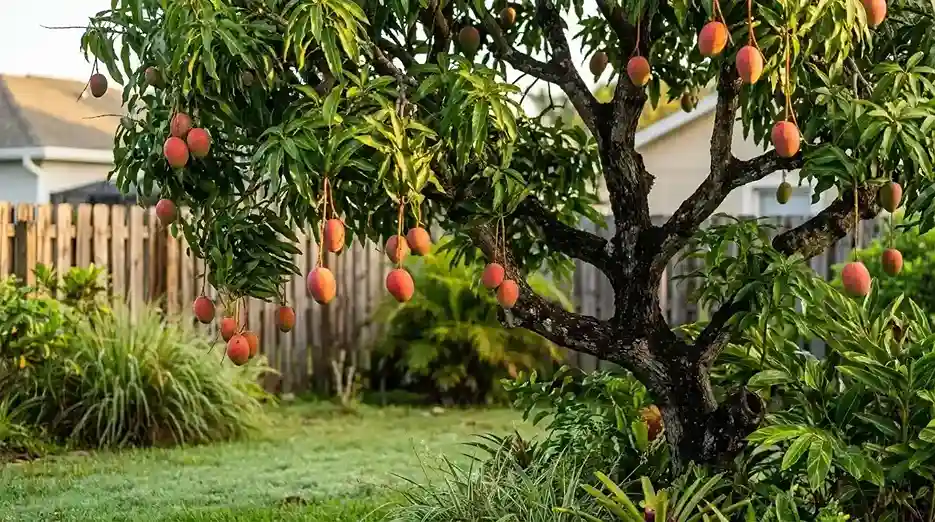
How to Grow Mango Trees for Juicy Summer Harvests
Few things feel more rewarding than picking a ripe mango from a tree you planted yourself.
Mango trees are beautiful even before they produce fruit. Their dense green foliage provides a tropical look, and when flowering begins, the tree can quickly become the centerpiece of a warm-climate garden. The challenge is getting the basics right from the start.
Mangoes are tropical and subtropical plants, and they respond strongly to temperature, sunlight, drainage, variety, and how they’re managed throughout the year. A tree planted in a sunny, well-drained location can behave very differently from one growing in heavy shade or constantly wet soil.
There’s also an important decision to make before planting: what kind of mango tree are you buying?
A grafted nursery tree is very different from a mango grown from a seed. Variety matters too, especially if you’re working with limited space or a climate that is only marginally suitable for mangoes. The University of Florida IFAS identifies grafting and budding on seedling rootstocks as standard propagation methods for mango, while agricultural guidance from TNAU describes approach and epicotyl grafting for planting material.
This guide brings the whole process together.
You’ll learn how to choose a mango variety, select a planting site, prepare the soil, plant the tree, manage watering and fertilizer, prune it into a useful shape, grow grafted mangoes in smaller spaces, deal with pests and diseases, and harvest the fruit when it’s actually ready.
The goal is not to give you a collection of quick tips that leave you searching for the next answer.
The goal is to give you a complete home-growing framework you can actually use.
EDITORIAL NOTE
Mango performance varies considerably with climate, cultivar, rootstock, soil, irrigation, and local disease pressure. The recommendations in this guide are intended for home gardeners and should be adapted to local conditions.
Table of Contents
Why Grow a Mango Tree at Home?

Mango is one of those fruit trees that can turn a backyard into something special.
The reward isn’t limited to the fruit. A healthy mango tree brings shade, structure, glossy foliage, seasonal flowering, and that unmistakable tropical feel.
But the fruit is certainly a big reason to grow one.
A ripe mango picked at home can be eaten almost immediately, and that gives you far more control over ripeness than buying fruit that may have spent days in storage or transit.
Mango trees can also be surprisingly adaptable when you choose the right variety and give them suitable conditions.
Some gardeners have plenty of room for a full-size tree. Others need a compact tree or a large container.
That’s where planning matters.
Before you buy a tree, think about the space it will occupy at maturity, not the little plant you’re looking at in the nursery pot.
Also consider your climate.
Mango is naturally suited to warm conditions. A tree may survive a brief cool spell in some locations, but that doesn’t mean it will grow or fruit well there.
That distinction is important.
You’re not simply asking:
“Can a mango tree survive here?”
You’re asking:
“Can I give this tree enough warmth and sunlight to grow well and produce fruit consistently?”
That’s a much more useful question.
🌿 PRO TIP
Treat your mango tree as a long-term garden investment. Spend more time choosing the right variety and location before planting than you spend looking for a miracle fertilizer afterward.
Another fruit plant worth growing at home
Choose the Right Mango Variety

The easiest way to make mango growing unnecessarily difficult is to choose a tree without considering its final size or your local climate.
A variety that performs beautifully in one location may be a poor choice somewhere else.
Start by thinking about three things:
Climate
Space
Fruit preference
If you’re planting in a warm tropical region with plenty of room, you have a wider range of options.
If you’re growing in a small yard, terrace, or large container, look for compact or naturally manageable cultivars and be prepared to prune.
Best Mango Types for Home Gardens
There isn’t one universally “best” mango variety.
The better choice is the cultivar that fits your growing conditions.
TNAU lists varieties such as Neelum, Banganapalli, Alphonso, Mallika, Amrapali, Arka Anmol, Arka Aruna, Arka Neelkiran, Arka Puneeth, and Sindhu among popular mango cultivars, with suitability varying by region and purpose.
If you’re shopping locally, nursery recommendations can be particularly useful because growers in your region are more likely to know which cultivars perform reliably under local temperatures and disease pressure.
For home gardeners, I’d put reliability ahead of novelty.
A mango with an impressive name isn’t much use if the tree struggles in your climate.
Choosing a Variety for Your Climate
Climate should influence your decision before taste ever does.
Mango trees need warm growing conditions, and cold can interfere with growth, flowering, and fruit development.
The original article makes several very specific claims about varieties tolerating temperatures around 30°F. I would remove those blanket claims rather than presenting them as universal facts.
Cold tolerance can vary with cultivar, age, tree health, duration of exposure, and whether the tissue is dormant or actively growing.
For gardeners in marginal climates, local extension advice is much more useful than a generic statement such as “this variety survives X degrees.”
Mango Trees for Small Gardens and Containers
This is where the choice of planting material becomes especially important.
A grafted tree selected for manageable growth is generally a much more predictable option for a small garden than planting a random mango seed and hoping for a compact tree with good fruit.
Container mango growing is possible, but it isn’t the same thing as putting a normal orchard tree into a tiny decorative pot.
The container needs enough root volume to support the tree, and the canopy must be managed.
Your biggest advantage is mobility.
A container gives you the ability to move the tree into a more protected location during unsuitable weather.
Growing tropical fruit in containers
Another tropical fruit that can be grown at home
Why Grafted Mango Trees Are Worth Considering

This is one area where I do recommend keeping grafting in the article.
For mango, grafting isn’t just a gardening experiment. It is an established propagation method.
A grafted mango combines a selected scion- the upper part that determines the desired cultivar- with a rootstock that supplies the root system.
That’s useful because a seed-grown mango may take longer to fruit and won’t necessarily reproduce the same fruit characteristics as the parent tree.
UF/IFAS identifies budding and veneer grafting on seedling rootstocks as standard mango propagation methods.
What grafting can give you
A grafted tree can offer:
- known cultivar characteristics
- more predictable fruit quality
- earlier fruiting than many seed-grown trees
- a more manageable starting plant
- the ability to propagate desirable varieties
This is why grafted mango trees are so popular.
Why Grafting Can Be Especially Useful in Small Gardens
A small garden has a different set of priorities from a commercial orchard.
You don’t necessarily want the biggest possible mango tree.
You want a tree that gives you good fruit without becoming impossible to manage.
That is where a grafted, appropriately selected cultivar can be extremely useful.
The University of Guam’s mango propagation material specifically describes grafting as a way of obtaining desirable characteristics, including earlier fruiting, a strong root system, compact tree form, and desired fruit qualities.
So your instinct about grafting is valid, but the wording matters.
I’d say:
Grafting can help you start with a known, desirable mango cultivar and can reduce some of the uncertainty associated with seed-grown trees.
I would not say:
“Grafting guarantees a small tree will produce a large crop.”
That would be too strong.
🌿 IMPORTANT
Grafting does not mean that every small mango tree will immediately produce a huge crop. A grafted plant still needs the right root system, sunlight, warmth, water, nutrition, and pruning.
Choose the Right Planting Site

Once you’ve chosen your tree, resist the temptation to plant it in the first empty patch of soil.
Location can determine the long-term success of the tree.
A mango needs:
- strong sunlight
- enough room for its canopy
- good drainage
- protection from severe wind where possible
- enough distance from structures and underground utilities
Think about the tree ten years from now.
Where will its branches be?
Will it shade the house?
Will roots interfere with paving?
Will you still be able to harvest the fruit?
Planning ahead is much easier than trying to redesign the garden around a mature mango tree.
Sunlight Requirements
Mango trees perform best in full sun.
Choose a position that receives strong direct sunlight for most of the day.
Shade can affect overall vigor and flowering, and a tree that spends much of its day under another tree is unlikely to perform like one growing in an open sunny position.
Don’t confuse “bright” with “sunny.”
A bright courtyard that receives only a little direct sun is not equivalent to a site with several hours of unobstructed sunlight.
Soil and Drainage
Mango can grow in several soil types, but drainage is important.
TNAU describes good drainage as preferable for mango establishment and gives an ideal soil pH range of approximately 6.5–8.0 for its production guidance.
Rather than forcing every gardener into one exact pH target, I would recommend testing your own soil and adjusting it according to local guidance.
The important principle is simple:
Don’t plant mango in a location that stays waterlogged.
Protection From Wind and Cold
A young mango tree can be vulnerable to both wind and cold.
Strong wind can damage branches, strip leaves, and destabilize young trees.
Cold can injure tender growth and flowers, and severe cold can cause significant damage.
Choose a site with some natural protection without sacrificing sunlight.
A wall or windbreak can be useful, but don’t place the tree so close to a structure that the roots and canopy become restricted.
Another warm-climate fruit growing
Prepare the Soil Before Planting

Healthy roots are the foundation of a healthy mango tree.
Before planting, check the soil rather than guessing.
A soil test can tell you much more than simply looking at the ground.
You’ll know:
- approximate pH
- major nutrient levels
- whether amendments may be needed
- whether the site is suitable without major correction
This prevents a common gardening mistake: adding several different products before knowing what the soil actually lacks.
Soil Testing and pH
Use a soil test before making major changes.
The target pH varies slightly among recommendations and local soils, so follow the guidance associated with your testing service and region.
The important point is to avoid blindly adding lime, sulfur, wood ash, or another amendment because you read somewhere that mango likes it.
Improving Poor Drainage
If the soil drains slowly, fix the problem before planting.
Possible solutions include:
- choosing another location
- planting on a raised mound
- improving the broader planting area
- using a raised bed
- growing a suitable tree in a container instead
The original mango article suggested simply adding sand to poorly draining soil. I would not keep that as a universal recommendation because the correct solution depends on the soil structure and site.
For a seriously wet location, changing the site is often a better long-term solution.
⚠️ COMMON MISTAKE
Don’t make the planting hole dramatically different from the surrounding soil and then assume the water problem is solved. If the surrounding ground remains saturated, the roots can still end up sitting in wet conditions.
How to Plant a Mango Tree

Once you’ve chosen the right mango tree and prepared the site, planting doesn’t need to be complicated.
The biggest mistakes usually happen when gardeners either plant too deeply, damage the root ball, or choose a wet location and try to solve the problem later.
Take your time at this stage. A mango tree may live in the same location for many years, so a little preparation now is worthwhile.
When to Plant
The best planting period depends on your climate.
In warm regions, mango can be planted during a favorable warm and relatively moist period that gives the tree time to establish before the most stressful weather arrives.
TNAU recommends planting during its regional July-to-December planting window, while other mango-growing regions use different schedules.
For a home gardener, the more useful rule is:
Plant when the soil is workable, temperatures are favorable, and severe cold or extreme heat is unlikely immediately afterward.
Don’t copy a planting date from another country or climate without checking whether it applies to your location.
Dig the Planting Hole Correctly
The hole should be wide enough to let the roots establish comfortably.
Don’t focus only on making an extremely deep hole.
UF/IFAS notes that planting instructions vary with soil type and warns that excessively deep planting can create problems; in sandy Florida soils, for example, its recommendations focus on loosening a broad area around the root system.
For a home garden, the important principle is:
The tree should sit at the proper level, with its existing root ball supported by the surrounding soil rather than buried deeply.
Handle the Root Ball Carefully
If you’re planting a nursery-grown mango tree, try to keep the root ball intact.
Don’t grab the trunk and yank the plant out of its container.
Instead:
- Water the plant beforehand if the potting mix is very dry.
- Remove the container carefully.
- Inspect the roots.
- Loosen only badly circling roots if necessary.
- Position the root ball in the hole.
- Backfill gently.
- Water thoroughly.
UF/IFAS specifically recommends inspecting nursery trees for healthy roots and avoiding severely root-bound plants because root systems that are badly confined may not establish properly after planting.
Pay Special Attention to the Graft Union
This is particularly important when you’ve purchased a grafted mango.
Do not bury the graft union.
TNAU’s mango guidance recommends keeping the graft union approximately 15 cm above ground level when planting grafts.
The exact commercial recommendation may vary with the planting material and region, but the principle remains the same:
The graft union should remain clearly above the soil.
Burying it can interfere with the intended rootstock/scion relationship and may cause unnecessary problems.
Water Immediately After Planting
Give the newly planted tree a thorough watering.
This settles the soil around the roots and removes large air pockets.
After that first watering, don’t keep the planting hole constantly saturated.
The objective is to give the roots enough moisture to establish while allowing the surrounding soil to drain.
Mulch, But Don’t Touch the Trunk
A layer of organic mulch can help conserve soil moisture and suppress weeds.
But don’t pile mulch directly against the trunk.
Leave an open ring around the trunk so the lower stem stays relatively dry and well ventilated.
🌿 PRO TIP
Before planting, place the tree in the hole while it’s still in its nursery container and stand back. Look at it from several directions. This helps you judge the planting position and future canopy before the tree is permanently in the ground.
Another fruit plant worth growing at home
Watering Mango Trees

Mango trees need water, but the amount they need changes dramatically as they grow.
A newly planted tree has a relatively small root system and needs help establishing. An older tree with an extensive root system is much more capable of finding available moisture.
That’s why a watering schedule that makes sense for a six-month-old tree can be completely excessive for a mature one.
Watering Young Mango Trees
The first few months are about establishment.
UF/IFAS recommends watering newly planted mango trees at planting and every other day for roughly the first week, followed by once or twice weekly during the first couple of months, with adjustments for rainfall and conditions. During prolonged dry periods, young trees may need additional irrigation.
Don’t treat those figures as a universal timer.
If you’ve just received several days of heavy rain, adding more water makes no sense.
Instead, consider:
- rainfall
- soil type
- temperature
- tree size
- recent irrigation
Watering Established Mango Trees
Once mango trees become established, their water requirements change.
UF/IFAS notes that mature mango trees generally need irrigation mainly during prolonged dry conditions rather than frequent routine watering.
That doesn’t mean you should never water an older tree.
It means you should stop treating it like a newly planted seedling.
Mature trees have larger root systems and generally tolerate short periods of dry weather much better than newly planted trees.
Watering During Flowering and Fruit Development
This is where timing becomes especially important.
You want enough moisture to avoid severe water stress, but you don’t want to create constantly saturated soil.
The exact irrigation strategy varies with climate, soil, tree size, and production system.
TNAU recommends regular irrigation during establishment, while other production guidance emphasizes adjusting irrigation according to the tree’s growth stage and environmental conditions.
For a home gardener, the practical lesson is simple:
Don’t let a productive mango tree swing repeatedly between severe drought and excessive watering.
Signs Your Mango Tree May Be Too Dry
Possible signs include:
- wilted or drooping leaves
- dry soil
- slowed growth
- premature leaf stress
- poor fruit development during severe drought
Look at the soil before deciding what to do next.
Signs You May Be Overwatering
Watch for:
- persistently wet soil
- poor growth
- yellowing foliage
- root problems
- declining plant vigor
If the site naturally drains poorly, simply watering less may not solve the problem.
The drainage itself may need to be addressed.
⚠️ COMMON MISTAKE
Don’t water a mature mango tree several times a week simply because you’re following the same routine you used when it was newly planted. Established mango trees generally need much less supplemental irrigation than young trees.
Care for another warm-climate fruit plant
Fertilizing Mango Trees

Mango trees need nutrients, but fertilizer should support good growing conditions rather than try to compensate for poor ones.
If your tree is planted in the wrong location, receives too little sunlight, or has constantly wet roots, adding fertilizer isn’t going to solve the underlying problem.
Start with the basics.
Then feed according to the tree’s age, soil, and growing conditions.
Young vs. Mature Mango Trees
Young trees are focused heavily on building roots, branches, and foliage.
UF/IFAS recommends more regular fertilizer applications for young mango trees and a different nutrient balance for mature, bearing trees. In its Florida guidance, nitrogen is reduced substantially for bearing trees, while potassium and micronutrient nutrition become more important.
This is an important point:
A mature fruiting mango should not automatically receive the same fertilizer program as a young growing tree.
Don’t Copy a Fertilizer Recipe Blindly
The current article gives fixed NPK formulas such as 10-10-10, 16-4-8, and 10-10-16.
I would not present those numbers as universal instructions.
Fertilizer recommendations depend on:
- soil fertility
- tree age
- tree size
- fruiting status
- climate
- existing nutrient deficiencies
UF/IFAS itself uses different fertilizer formulations for different stages and soil conditions.
For your readers, the better instruction is:
Use a fertilizer appropriate for mango and follow the product label, ideally guided by a soil test and local horticultural recommendations.
Where Should Fertilizer Be Applied?
Don’t dump fertilizer directly against the trunk.
Instead, distribute it around the active root zone.
TNAU recommends applying fertilizer away from the trunk and extending it toward the peripheral leaf drip area.
For a mature tree, that means thinking beyond the immediate area around the trunk.
Mango roots can extend well beyond the trunk’s base.
Avoid Too Much Nitrogen
This is one of the most important corrections to the original article.
More nitrogen means more leaves—but more leaves don’t necessarily mean more mangoes.
UF/IFAS notes that excessive fertilizer can reduce fruit quality or quantity and recommends much less nitrogen for bearing trees than for young trees.
If your mature mango is growing vigorously but flowering and fruiting poorly, don’t automatically increase nitrogen.
Look at:
- sunlight
- pruning
- flowering conditions
- irrigation
- tree age
- variety
- nutrient balance
What About Yellow Leaves?
Yellow leaves are a symptom, not a diagnosis.
They can result from:
- natural aging
- water stress
- poor drainage
- nutrient deficiency
- root problems
- pests
- disease
The original article assumes yellow leaves automatically indicate iron deficiency.
I would remove that statement.
UF/IFAS explains that iron management can be important in high-pH soils, but iron deficiency is only one possible explanation for yellow foliage.
If you suspect a deficiency, test the soil and inspect the plant before applying a nutrient treatment.
🌿 PRO TIP
Keep fertilizer away from the trunk and avoid feeding a stressed tree simply because the leaves look unhealthy. First determine whether the real issue is water, drainage, pests, disease, or light.
Quick Mango Tree Care Guide

Here’s a quick reference you can save before moving on to the more detailed sections.
| Need | Young Mango Tree | Established Mango Tree |
|---|---|---|
| Sunlight | Full sun | Full sun |
| Water | Regular during establishment | Mainly during prolonged dry periods |
| Soil | Well drained | Well drained |
| Fertilizer | Regular feeding may be needed. | More conservative, especially with nitrogen |
| Mulch | Helpful | Helpful |
| Pruning | Train structure | Maintain a manageable canopy. |
| Cold Protection | More important | Still important during severe cold |
| Support | Stake if necessary. | Usually unnecessary unless structurally needed |
UF/IFAS specifically recommends full sun, good drainage, regular watering during establishment, and much less routine irrigation once mango trees are mature.
Pruning Mango Trees

A mango tree doesn’t need to be cut back aggressively every year.
In fact, unnecessary heavy pruning can work against you.
The purpose of pruning is to create a tree that is strong, accessible, well-balanced, and appropriate for the space where it is growing.
A young mango benefits from some training because the shape you establish early can make the tree much easier to manage later.
Why Pruning Matters
Good pruning can help you:
- maintain a manageable tree height
- develop strong lateral branches
- remove dead or damaged wood
- improve access for harvesting
- improve light penetration
- make storm damage less likely
- Keep the canopy from becoming excessively crowded
UF/IFAS specifically notes that formative pruning of young trees increases lateral branching and establishes a strong framework for later fruit production. It also recommends selective removal of upper limbs to help maintain a lower canopy. (ask.ifas.ufl.edu)
The goal isn’t to make the tree look perfectly symmetrical.
The goal is to make it functional.
When to Prune
For established mango trees, pruning is generally best done soon after harvest.
This gives the tree time to produce new growth before the next flowering cycle.
UF/IFAS recommends pruning after harvest for early- and mid-season mango varieties, while late varieties may require timing adjustments in regions where freezing temperatures can occur.
Your local flowering and harvest season therefore matters.
Don’t copy a pruning date from a grower in another climate without checking when your own tree flowers and fruits.
How to Keep a Mango Tree Manageable
The easiest time to control a mango tree is while it’s young.
Rather than waiting until the tree is 15 or 20 feet tall and then attempting to cut it down dramatically, shape it gradually.
Select a few strong, well-spaced branches to form the main framework.
Remove:
- branches that cross and rub
- weak branches
- dead branches
- badly damaged growth
- shoots growing in awkward directions
- rootstock shoots below the graft union
UF/IFAS recommends selective pruning rather than allowing vigorous mango varieties to become extremely large. It notes that less vigorous varieties or trees managed through annual training and pruning can be maintained at considerably smaller dimensions than unpruned vigorous trees.
Avoid Severe Annual Pruning
There is a big difference between:
maintenance pruning
and
cutting a mature tree apart every year.
A healthy mango doesn’t need its entire canopy removed.
Severe pruning can reduce production for one or more seasons because you’re removing productive wood and forcing the tree to spend energy replacing its canopy. UF/IFAS specifically notes that severe canopy reduction can reduce production for several seasons.
If the tree has become enormous, don’t climb it with a saw and try to solve everything yourself.
Large-tree pruning can be dangerous.
UF/IFAS advises using a qualified professional for very large mango trees where climbing is required.
🌿 PRO TIP
Look at the height of your own reach before deciding how tall you want the mango tree to become. A tree that produces fruit at a manageable height is far more useful to a home gardener than a giant tree that requires a ladder every season.
Grafted Mango Trees and Container Growing

If you have limited space, a grafted mango tree can be a much more practical starting point than growing one from a random seed.
This isn’t because the graft magically changes the tree’s basic requirements.
It’s because you start with known plant material.
That’s valuable.
A grafted tree lets you choose a named cultivar while using an established rootstock. UF/IFAS identifies veneer and cleft grafting and chip budding among successful mango propagation methods.
Why Grafted Mango Trees Are Better for Many Home Gardeners
A seed-grown mango can be fun, but it comes with uncertainty.
Depending on the cultivar, a seedling may not produce fruit identical to the parent tree.
UF/IFAS explains that polyembryonic mango varieties can generally come true from seed, while monoembryonic varieties do not and need vegetative propagation to reproduce the same cultivar.
A grafted tree removes much of that uncertainty.
You know what variety you’re purchasing.
You know approximately what fruit characteristics to expect.
And you can choose a cultivar suited to your climate and available space.
Can a Grafted Mango Tree Fruit While Still Small?
Yes, a grafted mango can begin bearing much earlier than many seed-grown trees, but small size doesn’t mean immediate heavy production.
UF/IFAS reports that grafted mango trees can begin bearing around 3–5 years after planting under suitable conditions.
The actual experience varies.
A tree growing in a warm climate with excellent sunlight and good care may develop differently from one growing in a marginal climate or container.
Fruit production is also affected by flowering conditions, weather, variety, and the health of the tree.
So grafting gives you predictability and earlier bearing potential, not a guarantee of a huge crop from a miniature tree.
🌿 PRO TIP
When buying a grafted mango, don’t just ask, “Is it grafted?” Ask what cultivar it is, what rootstock was used if known, and how large the tree is expected to become in your area.
Growing Mango Trees in Containers

Growing a mango in a container is possible, but container growing changes the rules.
The root system has limited space.
Water can disappear quickly in hot weather.
Nutrients can be depleted faster.
And the tree can become unstable if the canopy gets too large for the pot.
That’s why container mangoes need more active management than trees planted in the ground.
Choose the Right Container
Use a large, sturdy container with excellent drainage.
The exact size should match the tree and cultivar rather than following one arbitrary pot-size rule.
As the tree grows, you may need to move it into a larger container.
A heavy pot is especially useful because mango trees become top-heavy.
Avoid placing a tall container of mango in an exposed area where strong wind could knock it over.
Container Soil
Use a high-quality potting medium that drains well while holding enough moisture for healthy growth.
Avoid heavy garden soil that compacts inside the container.
A good mix should allow:
- air around the roots
- adequate water retention
- fast drainage of excess moisture
The same rule applies here as with every mango planting:
Roots need moisture and oxygen.
Container Watering
A potted mango may need checking more frequently than one planted in the ground.
During hot weather, inspect the soil before watering.
When you water:
- Wet the entire root zone.
- Allow excess water to drain.
- Empty any standing water beneath the pot.
- Recheck the moisture before watering again.
Don’t create a cycle where the container is saturated every day simply because it is hot.
Container Fertilizing
Container plants have a limited supply of nutrients.
A suitable controlled-release fertilizer or other mango-appropriate feeding program can help maintain healthy growth.
However, don’t compensate for a too-small pot by endlessly increasing fertilizer.
If roots are crowded and the plant has nowhere to grow, fertilizer can’t solve the underlying restriction.
Keep the Canopy Proportional to the Root System
This is especially important for container growing.
A tree with a huge canopy in a small pot is more likely to become unstable and difficult to maintain.
Regular, sensible pruning can keep the tree compact.
The goal is not to punish the plant with severe cuts.
It’s to maintain a useful relationship between:
root space + canopy size + fruit load.
🌿 PRO TIP
For a container mango, choose the pot location before you fill it. Once a large container is packed with soil and a growing tree, moving it can become a surprisingly difficult job.
Mango Flowering and Fruit Set

This is where mango growing gets interesting.
A mature tree can produce an enormous number of flowers, yet only a fraction of those flowers will eventually become harvestable mangoes.
UF/IFAS notes that most mango varieties in Florida produce an average of less than one mature fruit per panicle, illustrating just how much natural flower and fruit drop occurs during the production cycle. (ask.ifas.ufl.edu)
So don’t look at a tree covered in flowers and expect every flower to become a mango.
That’s normal.
Why Mango Flowers Drop
Flower and young fruit drop can happen for several reasons.
Possible influences include:
- temperature extremes
- rain during flowering
- fungal disease
- poor pollination
- water stress
- nutrient imbalance
- natural fruit thinning
This means a tree losing many flowers doesn’t necessarily mean something is wrong.
Some drop is part of the plant’s natural reproductive process.
Protect Flowers During Wet Weather
Wet conditions during flowering can increase the risk of fungal disease.
UF/IFAS specifically recommends avoiding wetting mango flowers and fruit when irrigation is necessary because this can reduce fungal disease pressure.
Drip irrigation or watering directly into the root zone is therefore preferable to routinely spraying the canopy.
Don’t Overwater Just Because the Tree Is Flowering
This deserves emphasis because it is easy to get wrong.
Flowering does not mean the tree should be kept constantly wet.
Irrigation requirements depend on the climate, soil, and stage of development.
In some commercial mango systems, reduced irrigation before flowering is intentionally used to influence flowering, while adequate moisture becomes more important during fruit development. Those strategies are highly climate- and production-system dependent and should not be copied blindly in a backyard garden. (agritech.tnau.ac.in)
For the home gardener, the safest principle is:
Avoid severe drought stress, but don’t keep the root zone permanently saturated.
🌿 PRO TIP
Once your mango starts flowering, resist the urge to “help” it with lots of water and fertilizer. Flowering is a sensitive stage; stable conditions are generally more useful than sudden changes.
How to Encourage a Better Mango Harvest

There is no single trick that guarantees a huge mango harvest.
A good crop comes from several small decisions working together.
Give the tree enough sunlight.
Keep the soil well-drained.
Water according to the tree’s stage and weather.
Use fertilizer thoughtfully.
Maintain a manageable canopy.
Protect the plant from major pests and diseases.
Choose an appropriate cultivar.
That’s much less exciting than a secret fertilizer recipe, but it’s also much closer to how productive mango trees actually work.
Keep the Canopy Open Enough for Light
A crowded tree develops dense areas where light and airflow struggle to penetrate.
Selective pruning can help maintain a more open structure.
You don’t need to hollow out the entire tree.
Remove the branches that genuinely interfere with the structure.
Avoid Excessive Nitrogen
Nitrogen encourages vegetative growth.
That’s useful when a young tree is establishing itself.
But excessive nitrogen on a mature tree can encourage too much leafy growth at the expense of a balanced fruiting program. UF/IFAS recommends a more restrained nitrogen approach for bearing trees. (ask.ifas.ufl.edu)
So if your tree looks enormous and leafy but isn’t producing well, don’t assume it needs more nitrogen.
Keep Weeds Under Control
Weeds compete with young mango trees for water and nutrients.
A clean root zone also makes irrigation easier to manage and allows you to notice problems sooner.
Mulch can help suppress weeds and conserve moisture.
Keep mulch away from the trunk.
Don’t Try to Keep Every Fruit
A mature mango may naturally produce more young fruit than it can successfully carry.
Fruit drop is normal.
If a tree sets a very heavy crop, some natural thinning can occur.
The goal is a healthy tree carrying a sustainable crop, not forcing every tiny fruit to maturity.
🌿 PRO TIP
The best mango harvest isn’t necessarily the biggest number of fruits. Consistent tree health, good-sized fruit, manageable height, and reliable production year after year are better long-term goals.
Common Mango Pests and Diseases
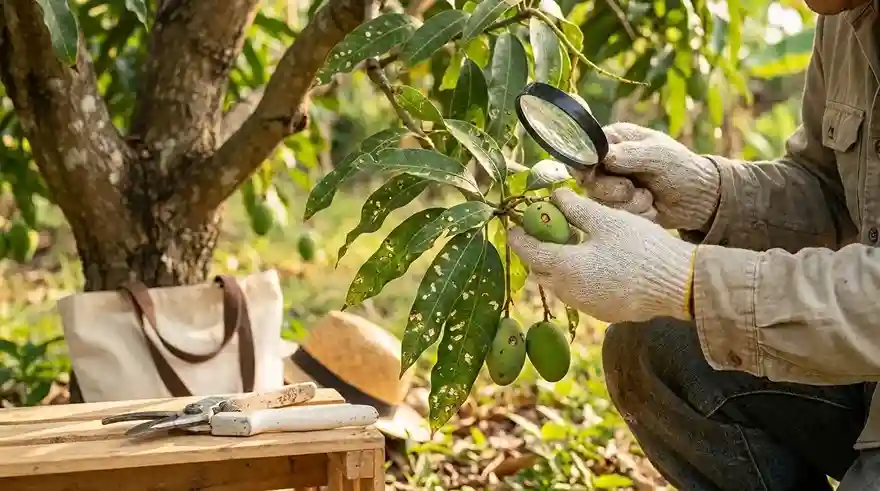
A healthy mango tree can still attract insects or develop disease.
That doesn’t mean you need to spray the tree every time you see one insect.
In a home garden, the better strategy is to monitor first, identify the problem, and intervene when the problem actually warrants it.
UF/IFAS notes that many mango insect pests don’t significantly limit fruit production and that control measures are generally justified when infestations become substantial.
That is an important distinction.
The presence of a pest isn’t automatically the same thing as a pest emergency.
Mango Hoppers and Flower-Feeding Insects
Mango hoppers and other small insects can become particularly noticeable around flowering.
If flower panicles become heavily infested, the insects can interfere with healthy flowering and fruit development.
Keep an eye on:
- flower panicles
- tender shoots
- young leaves
- developing fruit
Regular inspection is more useful than spraying on a calendar simply because flowering has started.
Mealybugs and Scale Insects
Mealybugs appear as small, pale, cotton-like insects, while scale insects may look like small bumps attached to branches or leaves.
Both groups feed on plant sap.
A light infestation may be manageable without aggressive treatment, particularly if natural predators are present.
For a persistent infestation, identify the pest first and use a product specifically labeled for mango and that pest in your region, following the label carefully.
Mites and Thrips
Mites and thrips can cause damage to leaves and tender growth.
Symptoms can include:
- stippling
- bronzing
- distorted leaves
- damaged young growth
- reduced vigor
UF/IFAS lists both mites and several thrips species among mango pests encountered in Florida.
Don’t automatically assume every spotted leaf has an insect infestation. Disease, weather injury, and nutrient problems can sometimes produce similar symptoms.
Fruit Flies
Fruit flies can become a concern as mangoes mature.
The exact species and management options depend on your region.
Good sanitation helps:
- Pick ripe fruit promptly
- Remove fallen fruit
- Don’t leave damaged fruit beneath the tree
- Inspect harvested mangoes carefully
If fruit flies are a recurring problem in your area, consult your local extension service for the appropriate monitoring and management program.
Common Mango Diseases

Disease prevention begins with how you grow the tree.
A mango planted in full sun with good air circulation is starting from a much better position than one crowded into a damp, shaded corner.
UF/IFAS specifically recommends growing mangoes where leaves, flowers, and fruit can dry quickly after rainfall and avoiding irrigation water on the canopy.
Anthracnose
Anthracnose can affect mango leaves, flowers, and fruit, particularly under warm, wet conditions.
You may notice:
- dark spots on leaves
- damaged flower panicles
- dark or sunken fruit lesions
- premature fruit loss
Wet weather around flowering can be especially troublesome.
Good airflow, appropriate spacing, full sun, and keeping irrigation water off the canopy can help reduce favorable conditions.
If disease pressure is severe, use locally recommended and crop-labeled management rather than relying on homemade sprays.
Powdery Mildew
Powdery mildew can appear as a white or grayish coating on flowers or other tender plant parts.
It is particularly relevant around flowering because infected flowers may produce fewer healthy fruits.
Again, don’t automatically reach for a fungicide every time you see something unusual.
Confirm the problem first.
Algal Leaf Spot and Other Leaf Problems
Not every spot on a mango leaf is caused by the same disease.
Environmental stress, insects, fungal diseases, and nutritional issues can all produce different types of leaf damage.
This is one reason photographs should be used as clues, not as definitive diagnoses.
When symptoms are severe or spreading rapidly, a local extension service or qualified plant professional can provide more reliable identification.
⚠️ COMMON MISTAKE
Don’t mix several home remedies together and spray them on your mango tree without knowing what you’re treating. Natural does not automatically mean harmless, and the wrong product can damage leaves, flowers, fruit, or beneficial insects.
Plant problem identification tools
How to Diagnose a Mango Problem Before Treating It

When a mango tree looks unhealthy, work through the basics before treating anything.
Ask these questions:
Has the weather changed?
Recent heat, cold, wind, or excessive rain can cause stress.
Is the soil too wet or too dry?
Check below the surface.
Is the tree receiving enough sunlight?
Shade can affect growth and flowering.
Are the newest leaves affected or only older leaves?
The pattern can provide useful clues.
Are insects actually present?
Inspect the underside of leaves and tender growth.
Are flowers affected?
Problems limited to flowering may have a different cause than leaf damage.
Is fruit developing normally?
Look for rot, spotting, deformation, or premature drop.
Did the problem appear suddenly?
Sudden changes can point toward weather injury, pests, or disease.
Mango Problem-Solving Table
| What You Notice | What to Check First |
|---|---|
| Yellow leaves | Water, drainage, nutrition, age of leaves |
| Leaf spots | Disease, insects, weather injury |
| Flowers turning brown | Wet weather, disease, flowering stress |
| Flowers but little fruit | Weather, pollination, variety, tree health |
| Premature fruit drop | Natural thinning, stress, disease, pests |
| Sticky leaves | Sap-feeding insects |
| White cotton-like insects | Possible mealybugs |
| Fine leaf stippling | Possible mites or other damage |
| Fruit with dark lesions | Possible anthracnose or other fruit disease |
| Weak growth | Light, roots, water, nutrition |
The objective is not to make you an expert plant pathologist.
It’s to stop the cycle of:
symptom → random product → more problems.
How and When to Harvest Mangoes

Harvest timing is one of the easiest parts of mango growing to get wrong.
A mango doesn’t necessarily need to be completely soft and fully colored while still attached to the tree.
In fact, many mangoes are harvested when mature but still firm and allowed to finish ripening afterward.
That’s especially useful for home gardeners because it gives you more control over the timing.
How Do You Know a Mango Is Mature?
Color alone is not a reliable indicator for every variety.
Instead, consider several signs together:
- The fruit has reached a mature size for the cultivar
- The shape has filled out
- The shoulders near the stem may appear fuller
- Skin color may begin changing depending on the variety
- The fruit begins developing a characteristic aroma
- A mature fruit may develop the expected external characteristics for its cultivar
The exact signs vary between mango varieties.
That means a variety-specific harvesting guide is often more useful than a generic statement such as “wait until the mango turns red.”
Some mangoes remain predominantly green even when mature.
Should You Pick Mangoes When They’re Soft?
Usually, no.
A very soft mango is generally already well into the ripening process and can be easily bruised while being harvested.
For fruit that needs to ripen indoors, a better strategy is to harvest mature fruit before it becomes fully soft.
How to Harvest Without Damaging the Fruit
For fruit within easy reach:
- Support the mango gently.
- Use clean pruning shears.
- Cut the stem rather than pulling the fruit.
- Handle the mango carefully.
- Place it into a shallow basket.
For high branches, use a purpose-built fruit picker with a collection basket.
Don’t climb an unstable ladder simply to reach one mango.
🌿 PRO TIP
A mango that falls hard onto concrete may look fine initially but develop internal bruising later. Put a soft collection basket under the fruit whenever possible.
Post-Harvest Handling and Mango Ripening

After harvesting, keep mangoes somewhere clean and at a suitable room temperature while they finish ripening.
Avoid throwing freshly harvested fruit into a refrigerator simply because you want it to last longer.
Cold storage is useful for ripe fruit, but immature fruit may not ripen normally under excessively cold conditions.
As mangoes ripen:
- The aroma becomes stronger
- The flesh softens
- The flavor becomes sweeter
- Skin color may change depending on the variety
Again, don’t judge maturity by skin color alone.
A green-skinned mango can still be ripe internally.
Storing Mangoes

Once a mango has ripened to the stage you want, refrigeration can slow further softening.
For longer storage, freezing is an excellent option.
Freezing Mango
To freeze your harvest:
- Peel the mango.
- Remove the seed.
- Cut the flesh into pieces.
- Spread pieces on a tray.
- Freeze until firm.
- Transfer to an airtight freezer bag or container.
Frozen mango works particularly well in:
- smoothies
- desserts
- sauces
- fruit bowls
- homemade sorbet
This is especially useful when your tree produces more fruit than your family can eat fresh.
Practical Ways to Use a Mango Harvest

A successful mango harvest doesn’t have to mean eating mango slices for breakfast, lunch, and dinner until you’re exhausted.
Fresh mango is incredibly versatile.
You can use it in:
- smoothies
- fruit salads
- yogurt bowls
- fresh salsa
- chutney
- desserts
- sorbets
- oatmeal
- salads
- grilled dishes
You can also combine mango with other fruit from your garden or kitchen.
For example, mango and pineapple make an excellent tropical fruit combination.
🍋 QUICK TIP
Freeze diced mango in small portions rather than one enormous container. That way you can take out exactly what you need for a smoothie or recipe.
Mango Growing Calendar

Your exact mango calendar depends heavily on your climate and cultivar.
Use this as a practical framework.
Spring
Focus on:
- new growth
- flowering
- disease monitoring
- irrigation management
- protecting flowers from prolonged wetness
- checking for pests
Summer
Focus on:
- fruit development
- watering during prolonged dry periods
- monitoring fruit
- pest control when justified
- harvesting mature fruit
- post-harvest pruning
Autumn
Depending on your climate and variety:
- continue harvesting
- reduce routine irrigation as weather cools
- inspect the structure of the tree
- plan winter protection if necessary
Winter
In warm climates, the tree may continue growing.
In cooler climates:
- protect young trees from damaging cold
- reduce unnecessary irrigation
- Avoid keeping roots wet
- Inspect for cold injury after extreme weather
Plant Growing Calendar by Location
Common Beginner Mistakes When Growing Mango Trees

Mango growing becomes much easier when you know which mistakes are worth avoiding.
Choosing a Tree Without Considering Mature Size
A tiny nursery tree won’t stay tiny.
Think about the eventual canopy before planting.
Planting in Poorly Drained Soil
A beautiful sunny location isn’t enough if the roots sit in water.
Drainage matters.
Watering Mature Trees Like Seedlings
Young trees need more help establishing.
Older trees have substantially larger root systems and usually need less routine irrigation.
Overusing Nitrogen
More leaves don’t automatically mean more mangoes.
Too much nitrogen can push excessive vegetative growth and hurt the balance needed for fruit production. (ask.ifas.ufl.edu)
Pruning Too Aggressively
Severe pruning can remove productive wood and reduce production.
Relying Only on Fruit Color
Some mangoes remain green when ripe.
Learn the characteristics of your cultivar.
Treating Every Insect as a Disaster
A few insects don’t necessarily require immediate pesticide treatment. UF/IFAS specifically advises that control is generally justified when infestations are large enough to matter.
Ignoring the Graft Union
When buying or planting a grafted mango, keep the graft union above soil level.
Frequently Asked Questions
Final Thoughts: Growing Mangoes at Home

Growing a mango tree is a long-term project, but it doesn’t need to be a complicated one.
Start with the right tree.
If reliable fruit is the goal, a good grafted cultivar is often a better starting point than an unknown seedling. Give it a sunny site with good drainage, and think about its eventual size before you put it in the ground.
Then keep the care straightforward.
Water young trees consistently while they establish. Don’t keep mature trees permanently wet. Feed thoughtfully rather than assuming more fertilizer means more fruit. Prune to maintain a strong, manageable structure instead of waiting until the tree becomes too large to control.
And watch the tree.
A gardener who regularly notices changes in leaves, flowers, fruit, soil, and weather will usually catch problems much earlier than someone who only looks at the plant when it’s time to harvest.
Grafting can make mango growing more predictable, especially when you’re working with a known cultivar and limited space. But it isn’t a shortcut around the fundamentals.
The tree still needs sunlight.
It still needs healthy roots.
It still needs suitable temperatures.
It still needs sensible watering and nutrition.
When those pieces come together, the reward is hard to beat.
One day you’ll walk outside, reach for a mango that has finally reached the right stage, and realize that the tree you planted years earlier is now giving you fruit.
That’s the part of growing mangoes that makes all the waiting worthwhile.

